4-18-26
Julie Shavers Looks Back: The Baptist Witches of Shelbyville
By Diane Sippl
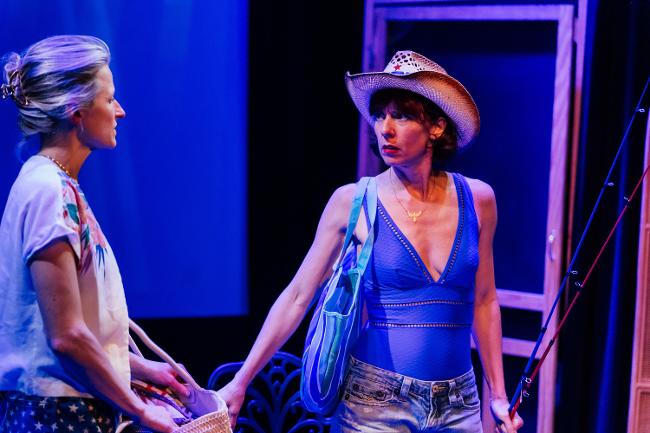
On crisp April evenings in Sherman Oaks, CA, the air turns sultry inside the Whitefire Theater as playwright Julie Shavers turns up the heat in small-town Tennessee for the world premiere of her new opus, The Baptist Witches of Shelbyville. Preparing for a 4th of July celebration, five generations of the Moon family—all women, that is—gather for the inherent rituals of a porch picnic, fishing at the lake, and patriotic song at the parade, but the glorious harmony of their voices stops right there. All that they presume to share (including lively raillery and sisterly quips and gibes) becomes almost superficial beside the longtime secrets the ladies have pushed aside—until they erupt as fireworks that truly bring light to the Shelbyville sky.
In the following comments, Julie Shavers reflects on the diverse aspects of creating live theatre, drawing directly from her own experience as a playwright and actor, especially since she wears both hats in her current production.
KINOCaviar I think of drama, in part, as a literary art (stemming from long traditions worldwide). Are there predominant metaphors in your play that you use to enrich your writing? We could start with your title, The Baptist Witches of Shelbyville.
Julie Shavers These women are not witches as most people think of them, but they cast prayer like incantation, call upon higher powers in times of need, rely on the strength of their circle and believe in the near supernatural powers of their matriarch. The difference is the source of their power, which is God, though I think God means something different to each of them. The second most obvious metaphor would be the names of the Moon girls, Kitty, Birdie, Lucinda and Lottie.
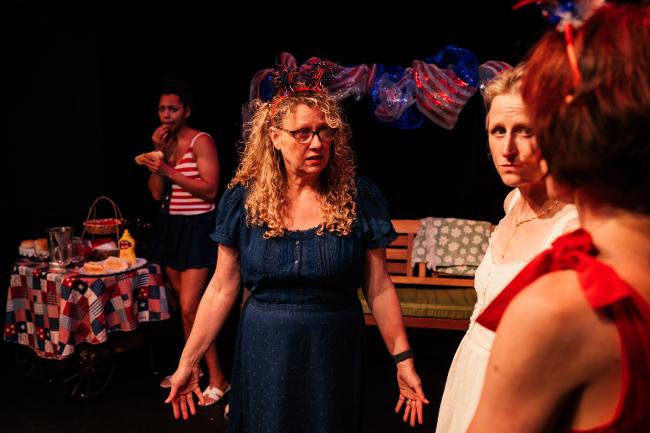
KC That said, as a live event, theatre allows a playwright to compose a work with extremely tactile imagery—not only by prescribing props and sets, but also by imagining the use of color and light, sound and music, even smell and taste that the writer wants to convey to the audience. How many of these details are written by you to evoke a specific atmosphere, and how much interpretation is left to the production crew in staging your play?
JS The opening stage directions in this play serve to set the mood. There’s a description of the porch, the sounds emanating from the house, the shifting light and the weather. The screen door was something I really wanted, because of the sound of it slamming and the fact that characters can hear each other from inside the house.
The red, blue and white of the sisters’ dresses is written into the final scene because they represent to me the fire inside of Birdie, the calm in the storm that Kitty provides and the new beginning that Lucinda paves the way for in her truth telling, while obviously being appropriate for singing at a July 4th event.
I love seeing what designers bring to my writing. I think every layer of creativity adds depth to the final piece. I couldn’t have imagined how much Cameron Clarke’s guitar music would move me, and every single night I find myself informed by it backstage as it plays right before my entrance.
I also like incorporating all of the senses. One of the first staged readings of this play took place on the back porch of my house in Los Angeles. I fed the audience fried chicken along with some other foods mentioned in the play while burning citronella candles as the sun went down. There were birds and wind chimes, and at the end our family band played some music inviting anyone who wanted to join in. It was magical. I’d love to incorporate more scent and taste in the theatre setting as well, if only I could do it without drawing rats and alarming the fire marshal.
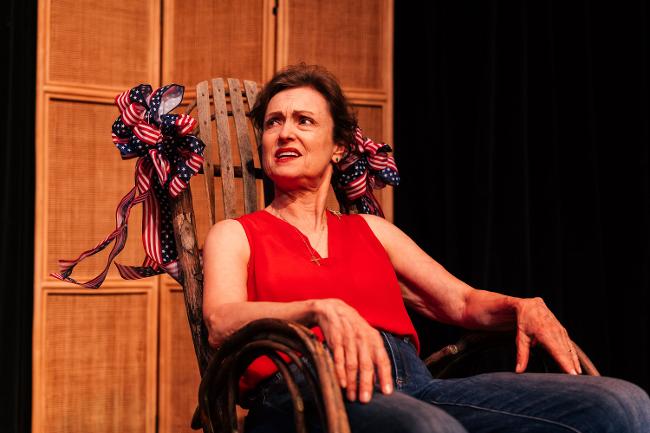
JS This production was directed by my husband Dan O’Brien, and while I wondered at first if it should be directed by a woman, I think he did an amazing job. He is a gifted actor himself and was able to steer us toward the honest, grounded performances that this play wants. He understands my comedy and rhythm probably better than anyone, after living with me for twenty-one years and directing two of my previous plays. I think he did a wonderful job with casting. If you get the casting right you are far more likely to get the performances you want. I definitely have performances in mind when I write, but I love being surprised by actors and deeply value the parts of themselves they bring to my work.
KC We could say that even more than plot or a “story arc,” theatre relies on the spoken word, not the written text; to create lines that crackle with wit or flow like honey, that pack a punch or linger over days, can be the playwright’s gift to the audience. How much of your dialogue is intuitive and spontaneous on your part and how much of it is finely wrought, written and re-written across time?
JS It’s both. I usually write a first draft in a flurry and then comb over it incessantly until I get to what feels right to me.
KC Most writers aspire to make a singular contribution to their métier; yet many of them feel they owe a debt to particular artists who came before them. I’m not boxing you in as a regionalist or “local colorist” to mention some predecessors—playwrights and narrative storytellers alike—whom I admire and who come from your ilk in portraying women in the American South. What do you think of the work of, for example, Eudora Welty, Flannery O’Connor, Kate Chopin, Carson McCullers, and Harper Lee? Maybe there are others, also men or more contemporary or international writers, who impress you more.
JS I think all of these writers are great. I would add Mark Twain, who I know is problematic racially, but turns a phrase like a magician. Barbara Kingsolver’s Demon Copperhead rings deeply true to me. There are characters in that book that felt like they were lifted straight from people I grew up with.
I love southern writers and am honored to be counted among them. I also identify strongly with writers who explore relationships and family dynamics. I love Toni Morrison, Maggie O’Farrell, Elizabeth Strout, Nora Ephron, Ottessa Moshfegh, Jane Smiley, David Sedaris, Jonathan Franzen, and James Baldwin. I read Steinbeck’s East of Eden for the first time last year and it’s gorgeous. It’s a great look at chosen family. I love to read, so this is a dangerous question for me.
KC The works of some of these writers have been made into films that are now “classics.” Can you see yourself writing a screenplay?
JS Absolutely.
KC By now in this conversation, it must have come out that your work may be fairly autobiographical. Can you comment on which ways that could be true? There has been much talk of “character-driven drama” in discussions of film as an art form. Is there a character in your play you feel is closest to your temperament, situation, or personal wisdom? Who most bears your legacy?
JS Lucinda is a writer from the South living in Los Angeles, so I guess in point of view, she is the most similar to me; however, each of these women pulls from my own personal experience as well as shared stories from the women in my family and circle of friends. Mama, for example, is not my mother; she’s an amalgam of people, and while her views differ greatly from mine, I drew from my own fears of imparting spirituality to my children to imagine how she might react when she feels her daughters slipping away.

Julie Shavers is a Los Angeles-based writer, actor, and choreographer. She participated in the Sewanee Writer’s Conference as a Tennessee Williams Scholar with Paula Vogel and was subsequently invited back to study with Naomi Iizuka. Previously staged productions include Silver Bullet Trailer at the Ohio Theatre, NYC; Go Robot Go at The New York International Fringe Festival; Sunshine on a Monkey’s Balls for The Vineyard Theatre, NYC; The Secret Life of Plants at The American Globe Theatre, NYC; The Kitchen is Small for The Planet Ant Theatre of Detroit, MI; and Lips and Assholes at the Red Room, NYC. Her dark satire, Mary Go Nowhere, premiered to critical acclaim at the Edinburgh Festival Fringe in 2017. Shavers was part of the Royal Court Theatre’s New York residency with Simon Stephens. Her television pilot, Beaumont and Beaumont, is currently in post-production.
The Baptist Witches of Shelbyville
Writer: Julie Shavers; Director: Daniel O’Brien; Producer: Black Rocking Chair; Scenic Design: Carmen Ziller; Lighting Design: Derrick McDaniel; Sound/Video Design: David Zuckerman; Original Music: Cameron Clarke; Costume/Props Design: Austin O'Brien.
Cast: Gigi Bermingham, Mamie Gummer, Julie Shavers, Angelie Simone, Ashley Ward, Juliana Liscio.
The Baptist Witches of Shelbyville runs at 8pm on April 17, 18, 25; May 1 at the Whitefire Theatre, 13500 Ventura Blvd. Sherman Oaks, Ca 91423.
Tickets are $40. Reservations: https://whitefire.stagey.net/projects/13984?tab=tickets