5-25-26
Hold onto Me: An Island Journey, A Girl’s Love Story
By Diane Sippl
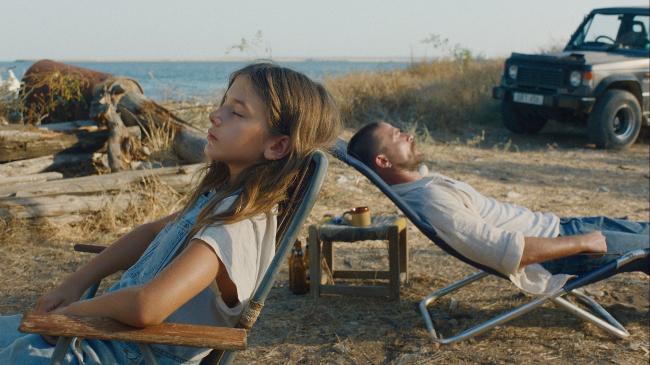
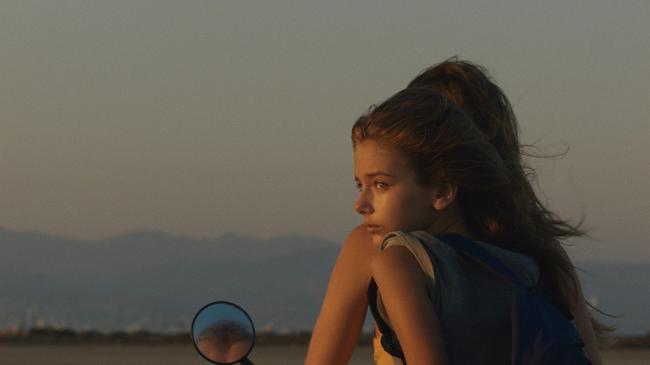
She takes off at break-neck speed on her bicycle, a small one but big enough for an eleven-year-old, crossing the barren surroundings that are her backyard, so to speak. He steals away in his truck to places unknown, at least to his daughter and, hopefully, to the men on his tail for the usual reason—money. The girl herself rounds up another vehicle, her bestie’s moped, enlisting this older friend to help her out with a midnight mission. It sounds like a chase scene, one of many in the film, but once in a while we see the girl on the back of her dad’s motorbike, holding onto him, and this becomes the presiding question—holding onto what?
From the shipyard to the open roads of the Greek side of Cyprus, the land itself mirrors the characters, father and daughter each an island unto themselves in the midst of the vast Mediterranean Sea. She longs for him so much that she would become his partner-in-crime, and at times she appears better at it than he is. But what kind of life is that? “You’re smart. You don’t need me,” he tells her. But what child doesn’t need a father?
The 20th Greek Film Festival Los Angeles is proudly presenting Hold onto Me by Myrsini Aristidou as its Closing Night Gala on May 31st. It’s worthwhile to hear about little Iris and how her writer-director has conceived of her across three films in her homeland of Cyprus. Here’s what the filmmaker has to say:
KINOCaviar Some of the most prolific and talented filmmakers have observed about themselves, “I’ve been making the same film all my life.” You’re still a newcomer, but it’s the third film you’ve made about a father-daughter conflict. To be sure, we need these—we have so few films about father-daughter relationships, especially made by women. Are you able to say why the theme compels you?
Myrsini Aristidou I am deeply drawn to stories about people who are emotionally or physically apart, yet life brings them together and they have to work to find ways to accept, understand, and love each other despite that distance. That interplay between profound connection and disconnection fascinates me, especially when it comes to the subtle awkwardness of human emotion and the things we oftentimes hesitate to say directly.
More broadly, I am interested in the dynamics between men and women and the roles society quietly assigns to both. The child usually becomes the emotional center of these stories for me. I am interested in how children (later turned adults) internalize emotional inconsistency, absence, or fragmented forms of love. Fathers and daughters, or the parent-child dynamic becomes a particularly revealing lens through which to explore that. In many societies, men are often expected to provide, remain strong, suppress vulnerability, and maintain control, but emotional presence is not always something they are taught. That contradiction interests me deeply.
Ultimately, I think these stories are about emotional inheritance and the way unresolved wounds quietly pass from one generation to the next. Often people repeat behaviors they themselves suffered from, even when they consciously reject them.
I suppose part of what compels me is the idea that, in order to move forward emotionally, we somehow have to confront and make peace with these inherited relationships, even imperfectly.
KC From at least three characters, or three times in the film, someone tells Iris: “Stay out of trouble.” At her age, how much trouble can she get into on an island like Cyprus?
MA Probably more trouble than adults imagine. Cyprus is small, but small societies can sometimes feel even more intense because there is little anonymity and everyone watches everyone.
Iris is at an age where curiosity, loneliness, and the desire to feel seen can easily push her toward risky situations. What interested me was the irony that her father, warning her to “stay out of trouble,” is more emotionally reckless than she is. In many ways, Iris is simply reacting to the instability surrounding her own reality.
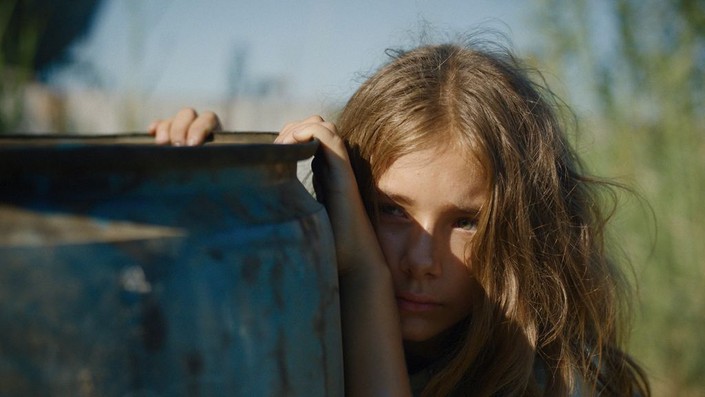
KC Early on, when Aris has to bail Iris (his daughter) out of jail, so to speak, he tells her, “Making the wrong decision is one thing. But you got caught. That’s something else.” The ironies pile up here, given Aris’ own situation. To what extent is Iris “a chip off the old block”?
MA Iris absolutely carries elements of her father within her. She is instinctive, observant, resourceful, emotionally quick, and capable of manipulating situations when necessary. Even when she resists him, she mirrors him.
What interested me was the idea that children inherit not only traits from their parents, but also emotional survival mechanisms. Aris has spent years using charm, avoidance, and improvisation to navigate life, and Iris is already beginning to develop similar instincts. The difference is that she is still young enough for her emotional trajectory not to be fixed yet.
KC Then again, Aris talks to Iris about his own father, “He wasn’t the best father, but knowing you’ll never see someone again, it’s tough.” This is quite an ironic comment, too, given how little Iris has seen of Aris. Do you think Aris “inherited” his indifference to parenting from his own father? Is parental absence typical for men in Cyprus today, or does it belong mostly to an older generation?
MA I think Aris understands emotionally, perhaps for the first time, that even flawed or distant relationships still leave deep marks on us. The scene is ironic because he is speaking about loss while simultaneously repeating a similar absence in Iris’ life. The idea is that people can carry grief and love for their parents even when those relationships were incomplete or painful. Family bonds are rarely rational. Someone can fail you deeply and still shape your emotional world forever.
As for Cyprus, I think older generations of men were often raised to believe that providing materially was enough, while emotional openness and vulnerability were not encouraged in the same way. I think younger generations are changing and becoming more emotionally aware and present, but there are still traces of emotionally unevolved attitudes for both men and women that continue to pass from one generation to the next.
KC After Iris “rescues” her father once or twice with her “own bag of tricks,” Aris wants to go his own way, but Iris clings to him. He tells her, “You’re a smart kid—you don’t need me.” In what ways is it actually Aris who needs Iris? Does he have more to learn from her than her clever schemes?
MA Aris needs Iris because she forces him into honesty. Iris still sees him clearly and might be the only one that accepts him without judgment. Around her, he briefly has the chance to imagine himself differently, perhaps even as someone capable of responsibility or tenderness. He can see himself as a better man.
So yes, I think he does learn more from her. Iris still possesses emotional courage. Despite everything, she continues reaching toward people, while Aris has spent years protecting himself through emotional distance.
KC Iris’ mother tells her, “He’s here to leave again. Just because he’s your own blood doesn’t mean you can trust him.” Should Iris trust her father?
MA Iris wants to trust her father more than she actually trusts him, and all because she longs for the idea of having a father around. Children instinctively hope their parents will become the version they need them to be. They are their “distant God” in so many ways, put on a pedestal, and many times justified for what appears to be an omnipresence, and a lack of physical presence. The difficult truth in the film is that both Iris and her mother are right in different ways. Aris is unreliable and emotionally dangerous at times, but he is not entirely incapable of love, either. That ambiguity was important to me because real relationships are rarely simple or absolute.
KC How did you find your two main actors for Iris and Aris? Did you use the same techniques in directing each of them?
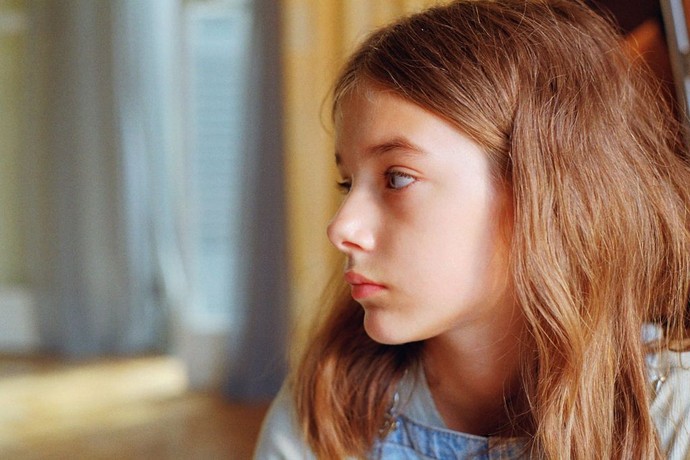
MA Finding the right actors was a very long process because the emotional balance of the film depended entirely on their chemistry.
For Iris, I needed someone who felt emotionally intelligent without seeming overly performative. Maria Petrova brought a natural innocence and maturity that immediately felt right. For Aris, I needed someone who could embody contradiction; charm, instability, tenderness, and danger all at once. Christos Passalis had that complexity naturally.
The directing process was different with each of them, but emotionally the approach was similar. I tried to create an atmosphere where they could remain instinctive and emotionally open rather than overly controlled.
KC Water itself seems to play a big role in your film. Was it challenging to work with the sea?
MA I grew up next to the sea, and it was always a kind of sanctuary, a place of escape and belonging for me. Emotionally, it has always carried a very particular feeling.
Depending on its state, the sea can feel calm, freeing, comforting, unstable, or dangerous, which felt deeply connected to the emotional world of the film. For Iris especially, it represents freedom and possibility. When you look at the horizon and there is nothing but water around you, it can make your own existence suddenly feel very small and insignificant. There is something both humbling and strangely comforting in that at the same time.
Practically, it was definitely challenging to work with. The sea is completely uncontrollable. The weather changes quickly, sound becomes difficult, and shooting near water is physically demanding. But because Cyprus itself is so connected to the sea, it naturally became part of the emotional texture of the film.
KC How many filmmakers are there in Cyprus today, and how many of them are women? Is there an actual infrastructure for creating works of cinema there, or mostly for working in television or live theatre?
MA The film industry in Cyprus is still relatively small, but it is growing steadily, and more women filmmakers have emerged and been recognized internationally in recent years. In fact, it sometimes feels as though there are currently more active women directors in Cyprus than men.
That said, the infrastructure remains limited compared to larger European countries. Cyprus historically had much stronger ties to theatre and television than cinema, so many filmmakers still rely heavily on international collaborations in order to make ambitious work.
At the same time, that lack of structure can also create a certain freedom. When there is no established path waiting for you, you are forced to invent your own.
KC You have been honored to be selected for numerous filmmaking labs and workshops throughout the world. In what ways did participating in them help you become the writer-director you are today?
MA The labs and workshops were incredibly important for me, especially coming from a smaller film industry where filmmaking can sometimes feel isolating. At the same time, I think some labs are more useful than others, and it really depends on what you are hoping to get out of the experience at that particular stage in your career or project.
Sometimes what is most valuable is the creative support in writing and developing the work. Other times it is financing, industry exposure, or simply the relationships and connections you build there. I think these programs become much more meaningful once you understand clearly what you are looking for from them.
For me personally, beyond the practical side, they helped me trust my instincts more deeply and defend my perspective, even when external pressures push toward something safer or more conventional. And regardless of labs, workshops, or external guidance, I think at the end of the day you still have to follow your heart and make the film that feels most honest to you.
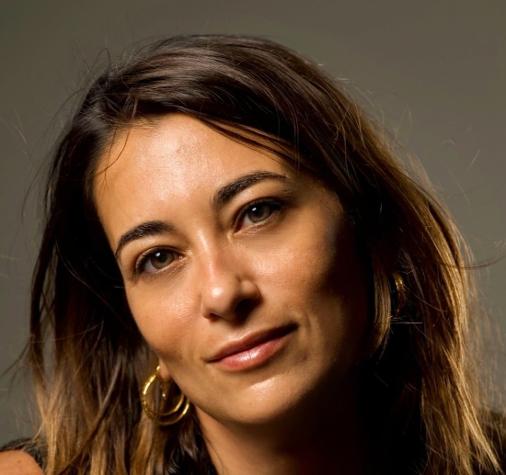
Myrsini Aristidou is a Cypriot filmmaker who has been building international acclaim for her work. Having studied Film and Art History at Pratt Institute in New York, she then earned her MFA at the prestigious NYU’s Tisch School of the Arts.
Her short films “Semele” and “Aria” premiered at major festivals including Venice, Sundance, TIFF, and the Berlinale, where “Semele” won the Jury Prize in the Generation section. Ms. Aristidou is also a former Cannes Cinéfondation Resident and an alumnus of the Sam Spiegel International Film Lab, TIFF Talent Lab, and Berlinale Talents.
Beyond her filmmaking, she is the founder of the Sagapo Children’s Foundation, an international NGO dedicated to empowering underprivileged children through education and creative learning initiatives.
Having already attended the LAGFF with her short film “Semele” in 2016, Myrsini Aristidou now returns with her feature film debut Hold onto Me. It screens at 6 pm on May 31st, following the Red Carpet at the Egyptian Theater in Hollywood for the Closing Night, which will include the bestowing of the tOrpheus Awards for the favorite films of the festival as decided by the jury and the audience, and then a Gala Reception in the Egyptian Courtyard.
Hold onto Me
Producers: Monica Nicolaidou, Myrsini Aristidou, Anders N.U Berg, Konstantina Stavrianou, Rena Vougioukalou; Director: Myrsini Aristidou; Screenplay: Myrsini Aristidou; Cinematography: Lasse Ulvedal Tolbøll; Editor: Jenna Mangula; Composer: Alex Weston; Production Design: Dimitra Sourlantzi; Sound Designer: Kostas Varympopiotis; Costumes: Sasia Paludan.
Cast: Christos Passalis, Maria Petrova, Jenny Salo, Aulona Lupa
102 min., Digital, Color. In Greek with English subtitles.