11-6-26
Elinor Gunn: The Heart of Heartbreak House
By Diane Sippl
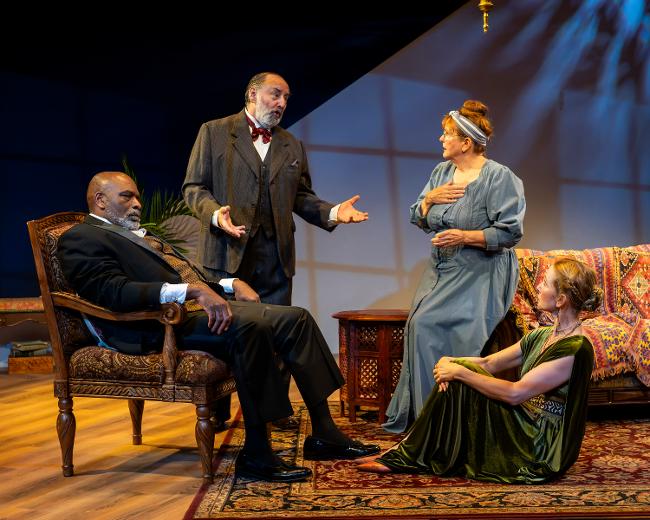
The Antaeus Theatre Company, standing proud in downtown Glendale, California and now celebrating its 35thanniversary, has always championed the classics of world drama and comedy staged by a first-rate ensemble of talented actors and crew. It opens this season with George Bernard Shaw’s Heartbreak House (October 11th –November 16th) helmed by Nike Doukas, herself the Artistic Director of the company and a frequent contributor to the productions. In fact, she has acted in six of Shaw’s plays and directed another one. But why choose Heartbreak House today? It launches a year (along with Stephen Sachs’s Miss Julie: Freedom Summer and Shakespeare’s Romeo and Juliet coming up) of “three plays that look at worlds gone mad and the individuals who step outside the boundaries in brave attempts to live life on their own terms,” as Nike Doukas puts it.
Shaw began writing Heartbreak House at the outset of World War I with the firm belief that aristocrats, rising capitalists, and bohemians alike were not facing Britain’s problems as an empire that had sought to colonize the world. Inspired by Chekhov’s sobering prototype The Cherry Orchard, Shaw created a riveting satire inside a cozy nest of the gentry oblivious to the upheaval inching into its own backyard. There are foolish romances to be sure, but as Nike Doukas observes, “Whether young, middle-aged or old, whether moneyed or impoverished, all the characters in this play are at war with themselves. Each of them is grappling with a personal struggle concerning self-fulfillment, and all under the unnamed but ever-present cloud of The Great War. Their ‘house’ is in disorder.”
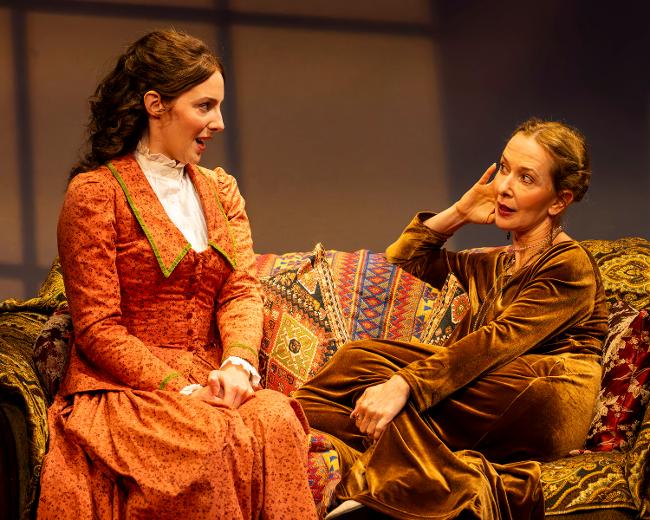
At the heart of this ever-turning kaleidoscope of pretenders and deceivers is a prim young woman, Ellie (Elinor Gunn), innocent enough in her naïveté, who enters this house for a weekend of mayhem. Deeply befuddled, she is tossed about in a “wild sea” of outlandish behavior owing to the flaunting of defied conventions and social intrigues until finally she is left to her own devices to discover her place in the world.
Working with the Director and the Ensemble
KINOCaviar How did you end up getting cast in your role as Ellie? What was it like working with Nike Doukas, the director? Had you worked with her previously? Was her directing different for Heartbreak House from her approach to other plays?
Elinor Gunn I am very fortunate that I’ve worked with Nike multiple times in different theatres, so she’s very familiar with my work and she pays me the great honor of simply offering me roles she thinks I’d be good for, which was the case with Ellie. I’d worked with her on Shaw before, back in 2021 in Arms and the Man, and twice at Antaeus in The Tempest and Cymbeline. Her direction style has spoiled me terribly, because she really is an actor’s director. She lets us work out the subtext and story beats slowly, allowing the play and our purpose in it to develop over time as opposed to micro-managing every moment before we’ve even made sense of it for ourselves. I love working with her and will accept anything she asks me to do; she’s never steered me wrong and has given me some of the best acting experiences of my life. I’m very, very grateful to her.
KC Did you learn anything from the other actors in the ensemble? How did you work together to arrive at a unified style?
EG I learn every night from these exceptional actors. They are all titans of their craft and have worked in so many different places and for many years. It’s a masterclass every night onstage, and the rehearsal room, and now backstage, is truly a joy. We all get along so well, which is a delight and can be a rarity in this business. Nike steered us to a shared language with the play, of course, but I think we all really understand the play and want to share the truth of what George Bernard Shaw wrote with the audience.
Shaw and Women
KC Shaw can hold a particular sensitivity toward women—do you think this production captured it?
EG Shaw is inherently a feminist. He was also a pacifist, and disagreed with Britain entering the war. As a playwright, he critiqued gender roles and gave women wonderful scenes together discussing the practicalities and difficulties of their existence at the time. He writes so beautifully and with such sensitivity about the struggles of women trying to find their footing in a world built for men.
Shaw’s Characters
KC How would you describe your relation to Captain Shotover? Do Ellie’s impressions of him change? How does she learn to become a judge of character in the course of the play?
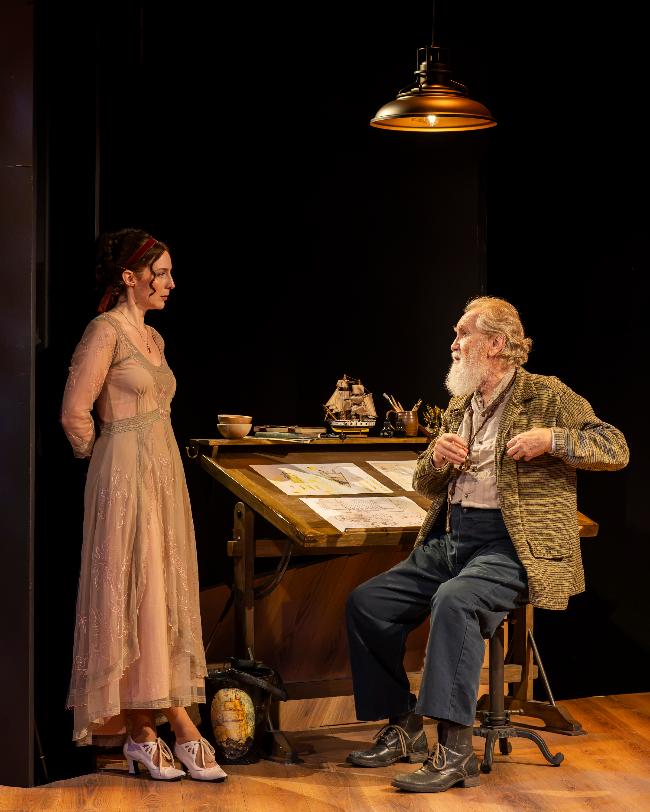
EG The relationship between Ellie and Captain Shotover is the heart of the play. They gravitate toward each other like magnets, like they’ve known each other before. Of course she is taken aback by the Captain’s way of speaking at the beginning of the play, everyone is. But he’s frank and has a past, and Ellie finds him fascinating. There’s a conversation between the two of them which I think is just a perfect scene. It’s worth the price of admission. Shaw wrote about two people who can just be honest with each other, even though they’re speaking from completely different stages in life. It was the scene I read that made me want to do the play. That and the ending.

Heartbreak House Today
KC What might it be about Ellie that resembles our youths today? Has her predicament changed in a century?
EG Ellie’s desire to find stability in a precarious world is absolutely something the younger generation can understand, and feel most deeply. She is forced to be practical, hardened by the world she lives in. The fact that this play was written over a hundred years ago and the issues she faces are still so much the same speaks volumes. Her belief that she must marry rich to have a chance of living is something I hear so many young women say today. I think the beauty of her journey is that she chooses love at the end, in spite of her (totally valid) worries, her “spirit is not dead,” and she doesn’t sacrifice her romantic heart for material gain.
KC Do you see Heartbreak House as particularly relevant to our world outside the theater? If so, how?
EG I think Heartbreak House is a masterpiece. It is prescient and timely in a beautiful and terrifying way. A major theme in the play is dreaming, dreaming of the world one wishes they were living in but is so different from their current reality, and reality crashing down on us in the pursuit of trying to figure that out. Life continues to “go on,” as Shaw says in Act 3, and war, poverty, crime, all continues in spite of our wishing it wouldn’t.
Elinor Gunn and Acting
KC You play a woman who is nearly adolescent in age, yet you are quite experienced and versatile as an actress. Is your role as Ellie comparable to any others you have played?
EG Thank you for the compliment! I find Ellie to be an exquisitely crafted character, with a full, delicious arc that is a joy to play and discover anew every night. She’s very different from many “ingenues” in that she lives a full life in front of us, is disillusioned, grows up, hardens and softens and ultimately chooses joy with Captain Shotover.
Heartbreak House
Playwright: George Bernard Shaw; Director: Nike Doukas; Assistant Director: Olivia Freidenreich; Costume Designer: Kate Bergh, Scenic Designer: Angela Balogh Calin; Lighting Designer: Karyn D. Lawrence; Sound Designer: Carter Dean; Props Designer: John McElveney; Fight/Intimacy Director: Jen Albert; Dialect Coach: Sean Spann; Production Stage Manager: Melissa Graff; Assistant Stage Manager: Jessica Osorio
Production Generously Sponsored in Part by Daniel Saxon, In Honor of Channing Chase
Cast: Bernard Addison, Alex Barlas, Harry Groener, Arye Gross, Elinor Gunn, Alberto Isaac, Henri Lubatti, Carolyn Ratteray, Jocelyn Towne, Amelia White
October 11-November 16, 2026 Antaeus Theater, Glendale Tickets at: www.antaeus.org