10-12-26
20th German Currents
Look Out! History Is Now… and Everywhere
By Diane Sippl
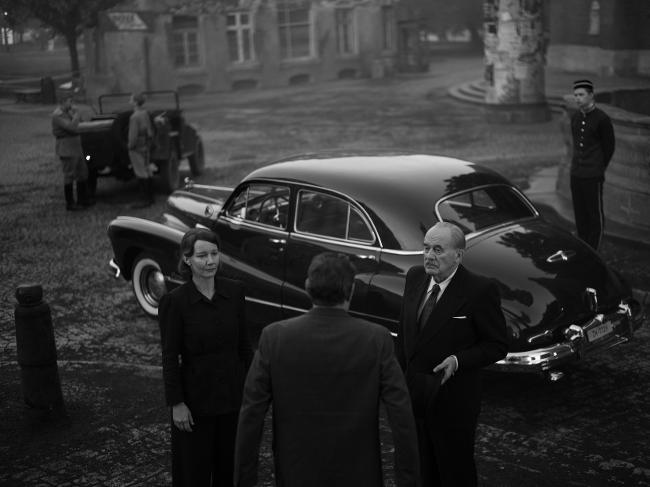
Exile creates a special form of life, and the various reasons for banishment or flight make little difference, whether the cause is leftism or the opposite — the sharing of a common fate and class solidarity are more fundamental than nuances of opinion, and people find their way to one another.
— Thomas Mann
Everything is a bit ambiguous and paradoxical, and let’s think again—how did it all look? I left Poland when I was 14 and lived in different countries. I couldn’t help noticing how everything looks different depending on where you live and which generation you belong to, so I can’t help seeing complexity where others see straight-forwardness.
— Paweł Pawlikowski
Now, more than ever, for the 20th edition of the German Currents in Los Angeles, it’s fun to consider “currents”—as we do with cinema itself—in terms of movement in both time and space. The word can refer to what is new and in-the-moment, happening now, and also to what flows from afar, arriving on our shores. Fanning out from their presenter, the Goethe Institut near Downtown Los Angeles, this year’s films are screened at theaters in Santa Monica, Culver City, Los Feliz, and Gardena from October 8th-13th. More to the point, this year the program highlights international filmmaking—German co-productions with Poland, France, Italy, Austria, Albania, and Japan, for example. Furthermore, many of the films are set in decades throughout the 20th century at key moments when domestic politics loomed so large as to thrust people up against cross-cultural questions, to confront them personally and intimately in much the same way that we face those same issues today.
For example, what does exile mean, not only from one’s homeland, but possibly also from one’s adapted land, even from one’s birth family or one’s children—or from oneself? What are the costs of war, whether fought with bombs or ideas, and its toll on an individual’s identity, one’s ties to a spouse or sibling, one’s future? Is digging up the past, both literally and figuratively, a necessary liberation? An unwelcome revelation? A move toward closure that opens itself again and again? Such is history—one person’s dream, another’s torment, and always in re-play. Thus we re-visit, on the big screen, in major style, and with hindsight, even déjà-vu, those lingering images in the afterglow of the theater, in the warmth of a shared experience with a live audience, even with the filmmakers themselves, and with a “Prost!” in the lobby.
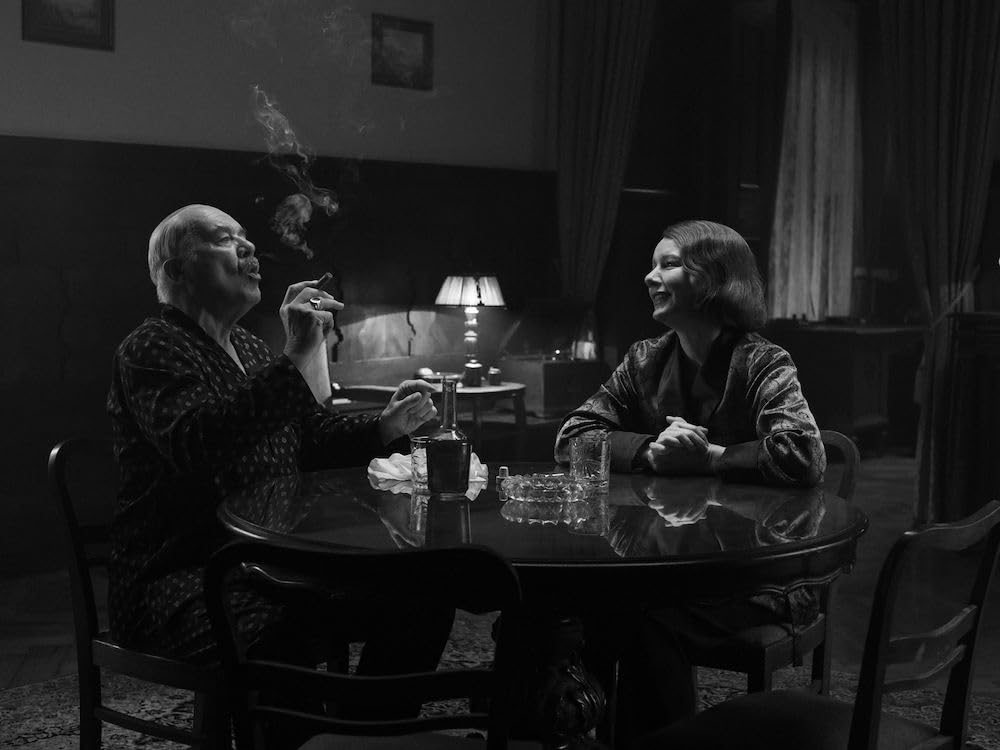
Beware, oh wanderer, the road is walking too.
— Jim Harrison, after Rainer Maria Rilke, in Donna Rifkind, The Sun and Her Stars
Fatherland, showcased as the Opening Night feature of the 2026 German Currents and discussed by its director and co-writer, Paweł Pawlikowski, following the screening, emerges from his already significant oeuvre derived from Europe’s WWII history and its aftermath. In this case his focus looks exceedingly tight—the moment in 1949 when German Nobel laureate Thomas Mann returns “home” after 16 years of exile in the U.S. He and his family were stripped of their German citizenship under the Nazi regime; they fled from Munich in 1933 for the U.S., yet now Mann is facing an exodus from his home in California under McCarthyism, and he is being all but “escorted” by the CIA.
Addressing such subject matter—a return to the rubble of this old country newly divided as it was between “East” and “West”—would seem to proffer a contrast between communism and capitalism, the confrontation between the Soviet Union and the U.S., or between two icons, as Mann himself puts it, “between Stalin and Mickey Mouse.” Yet audiences accustomed to films with clear conflicts neatly packed into genre boxes for ease of consumption may be surprised with Fatherland. Latching onto the “right” lenses to view the work with a familiar perspective could be challenging. Not the “road movie” it soon enough appears to be, from Frankfurt in the West to Weimar in the East, and never becoming a full-fledged “bio-pic” of Thomas Mann nor even a docudrama of two real speeches he gave days apart, Fatherland emerges as a cinema portrait—a miniature at best—but of whom?
The film opens with an intimate scene of Klaus Mann, his father’s eldest child, sitting naked on the floor and lost to the world, exposed and tragically vulnerable as he confides on the telephone with his faraway sister Erika, his lifetime alter-ego of sorts, while his lover silently retreats from the bed and the bedroom. This quick prelude that hangs like a black cloud over the entire film is a unique venture in voyeurism, one that funnels this fundamental aspect of cinema through a rather autobiographical keyhole that taps the filmmaker’s own life experience in another time and place. The result is not so much “false” as disorienting. We are definitely looking at a crucial moment of history, but one almost frozen in time and played out on our screen as a gorgeous tableau vivant with all due fidelity to physical ambience and political atmosphere; the question of whose point of view it represents becomes important.
Pawlikowski refers to his film as akin to a classical Greek family drama with Erika Mann, the favorite daughter/symbiotic sister positioned between the two writers, father and son. Thomas Mann was in Germany to receive the Goethe Award and Klaus Mann was in Cannes at the same time, some thirteen years after he wrote the banned Mephisto, based on the famous actor Gustaf Gründgens, Klaus’s ex-lover and Erika’s ex-husband, who “sold his soul” to the Nazis. We soon hear that Klaus has died in depression and despair, taking his own life, and his father’s only utterance, as if to console Erika, is, “He was a spoiled child who always needed extra attention… he shouldn’t have done that to your mother, or to you.” As a family drama, Fatherland serves neither mother nor daughter. In fact, it was Katia Pringsheim, Thomas Mann’s wife, herself of Jewish descent, who accompanied him on this return to Germany to receive the Goethe Award, but we neither see nor hear her except in voice-over on a distant phone line that is breaking up.
As for Erika, we see her shaving her father’s beard, chauffeuring his car, translating at his press conferences, even editing his speeches and, especially, walking out from his pompous, hypocritical West-side receptions and his East-side ceremonial pageants alike, but we’re hard-pressed to know her as the writer, actress, and activist she was against the Third Reich. Gifted and unstoppable, she had a mind of her own, quite possibly inherited from her strong-willed mother and most definitely shared intimately with her brother Klaus all his life. As for Klaus, he died of an overdose of pills in May of 1949, four months prior to Mann’s arrival in Germany, but with dramatic license, Pawlikowski places him right in the middle of his father’s four-day German sojourn, and not with Mann’s wife but with his daughter Erika.
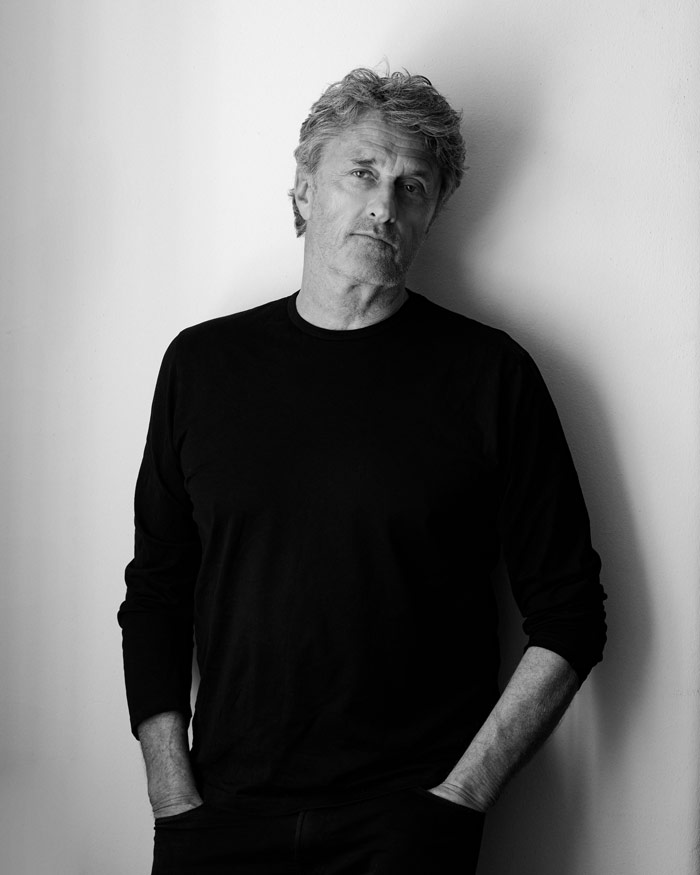
I did re-arrange some aspects: Klaus had killed himself about four months before that trip, not during it, and Erika’s ex-husband and her girlfriend didn’t see her at that time; I added them.
Again, I made this film because the Cold War is familiar to me—I grew up in it.
— Paweł Pawlikowski
Pawlikowski’s own father was of Jewish descent, and it was only in his late teens that the adolescent Paweł discovered that his father’s mother had died in a concentration camp in Auschwitz. Before that, when he was only 14, he experienced exile directly for the first time when his mother took him from Poland to London, if only for one year, at which point their visas expired and they were again exiled, this time to West Germany, where they reunited with Pawlikowski’s father, who himself had fled Communist Poland separately due to antisemitism. The family finally settled in the UK, where in 1977, studying literature and philosophy at Oxford University, the son Paweł followed in the tracks of his mother, who had been a professor of English literature at the University of Warsaw; however, following an internship with the BBC and making documentary films about the demise of the Soviet Union, Pawlikowski once again returned to Poland in 2013 and began to develop his stringent black-and-white cinematic style for historical fiction films that have brought him renown to this day. In many ways, they paint a vivid picture of his life.
Thomas Mann’s fiction itself can be quite autobiographical, so there is no reason to say that narrative license can’t be valid in creating a work of art; yet might Pawlikowski’s sensibility of Thomas Mann’s “Fatherland” of Germany, East or West, be comparable to the director’s own reflections on Poland, pre- and post- WWII, the land of his own father, to which the filmmaker himself returned to create his art?
My style has been characterized as cool, unemotional, restrained. It has been said — in praise or blame — that it lacks grand gestures, passion; that it is the instrument of a rather slow-moving, sardonic, and conscientious mind rather than that of a tempestuous genius. Well, I have always been cognizant that the literary landscape which can be described in such terms is Low German, Hanseatic, Lübeckian.
—Thomas Mann
The director claims that a pared-down style allows him to create scenes that are intensely interesting in and of themselves, so as not to explain too much or become didactic, serving merely as building blocks in a predictable script. The tableau vivant serves this purpose and more; historically such pictorial stagecraft has been used for protest purposes, silently drawing and fixing attention on key content. What’s interesting here is that Mann’s own demeanor, culturally patrician and internationally diplomatic, lends itself quietly to the form.
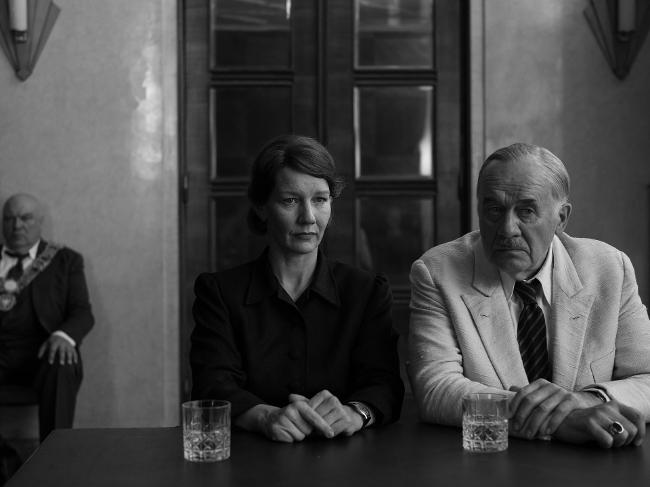
Cinematographer Łukasz Żal’s style is observational, here less dynamic and more sedate, with Mann himself often appearing paralyzed in rumination of a country buzzing with denial—the West of its fascist complicity and the East of its remaking of the Buchenwald concentration camp into a Soviet prison, for example.
Pawlikowski is known for stark cinematic images, and in the case of Fatherland he does actually “sculpt” them together, often defying the “suture” system of conventional plot-oriented cinema to let the viewer linger on sensations beyond story-telling logic. Thomas Mann himself encouraged his readers to consider various “modes of being”: for example, the atmospheric as opposed to the physical, or the acoustic instead of the visual.
Perhaps Pawlikowski is most “Mann-ian” with his use of music. In Fatherland, much of it is vocal—night club entertainment/dance singing at receptions in the American-occupied West, and staged/structured/disciplined group choruses to honor Mann and the new Soviet bloc in the East. The utter lack of music is also striking in the contemplation-begging funerals of Klaus, one public and one private. Their silence creates a special place for a final scene. The film ends with a memorable two-shot—Thomas Mann and Erika Mann, father and daughter, visit a cavernous church that is eerily empty but for a pipe organ on the balcony. They sit side-by-side below, facing us, listening, relishing the music, holding hands, then clasping them—beloved father and beloved daughter. Words do not suffice. With the effective “cinematic architecture” Pawlikowski has constructed all along in the atmosphere of what is broken and lost, it’s a frame that embodies all the paradoxes and complexity of the historical moment, of the film. It’s there that Pawlikowski achieves his ultimate portrait of “Fatherland.”
Fatherland
Producers: Mario Gianani, Lorenzo Mieli, Ewa Puszczyńska, Jeanne Tremsal, Edward Berger, Dimitri Rassam, Lorenzo Gangarossa; Director: Paweł Pawlikowski; Screenplay: Paweł Pawlikowski, Henk Handloegten; Cinematography: Łukasz Żal; Editors: Piotr Wójcik, Paweł Pawlikowski.
Cast: Hanns Zischler, Sandra Hüller, August Diehl, Anna Madeley, Devid Striesow, David Menkin, Joachim Meyerhoff, Enno Trebs, Theo Trebs, Waldemar Kobus, Milan Peschel, Daniel Wagner.
82 min., DCP Projection. In German, English, French, and Russian with English subtitles.