5-7-26
Two Cultures, Two Bards, One Music:
Senegalese Ablaye Cissoko and French Cyrille Brotto at the TRK
By Diane Sippl
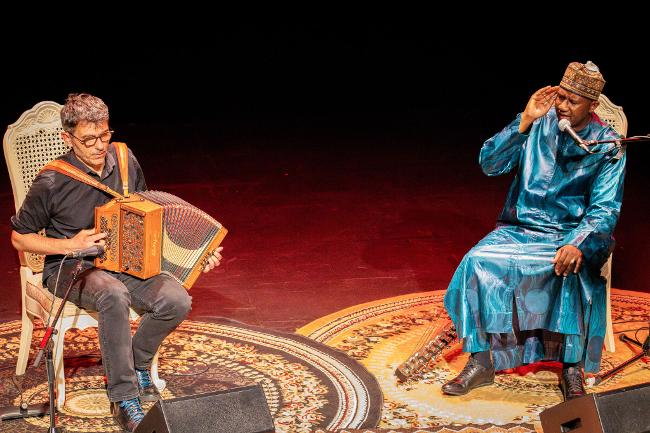
He whispers, he sighs, he speaks—but mostly in song, his creamy tenor voice soft and reverent, plaintive, or occasionally, boisterous and demanding in its grief:
“We are losing our youths. Their parents can’t feed them, and the children know it, so the young ones leave home to go abroad in search of a better life. Their departure is filled with risk, and their parents beg them not to go, but they go, they go in face of peril…. In all of this, the hardest part for the parents is knowing that their children have left exactly to provide for them, because they cannot do it themselves.”
In his diaphanous aqua boubou, on a starlight blue stage, Ablaye Cissoko laments the loss of Africa’s youths swallowed at sea by the raging Atlantic, and so he sings as he plucks his kora.
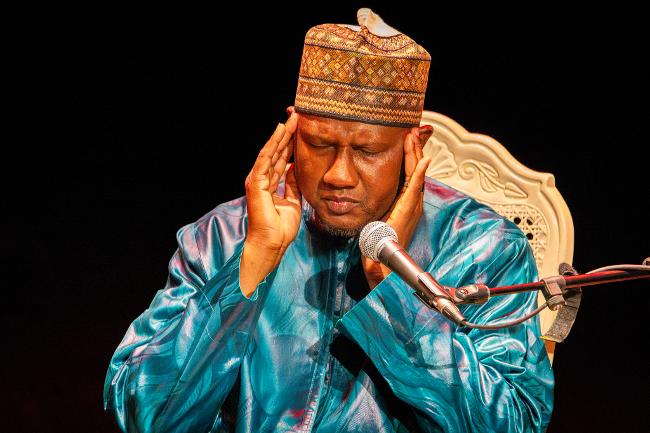
“This song is called ‘Djiyo’”
“Water… too much water” was also the central motif of Cissoko’s lyrical passage introducing the opening selection, “Djiyo,” with accordionist Cyrille Brotto at the Théâtre Raymond Kabbaz on May 7th. Cissoko spoke in French (spontaneously interpreted into English by an audience member he drew to the stage) about rain:
“In the rainy season the sky starts changing color and the birds are changing their flight. The rain starts falling and the earth is shaking with happiness. The farmers are going to the fields and sowing seeds, or harvesting greens and other vegetables. Women are outside washing the clothes under the rain. The young people are out playing sports, dancing, and singing. It’s festive—a party. And some others want nothing to do with this water, because this water creates flooding.
For years people have been saving money and trying to work around the water, but it has settled in the area, making their plans impossible to carry out. In some places, its effects are very violent. Water leaves a lot of damage in its wake. Whether these disasters occur naturally or are due to human causes, they take a huge toll on human life.
People from neighboring villages come to help, to give a hand. Some people come with rice, others with milk, medicine as well, and some come with their support because these disasters can come up again, and continue to happen. And this solidarity is extremely important, because what happens in a place elsewhere could totally happen here one day. And when this happens here, we will need other people for their help. We have to refuse to be divided. Let’s continue to act in solidarity with one another. Merçi.”
Cissoko plays his kora and sings in Wolof. The audience, avid listeners in any language, have devoured the message.
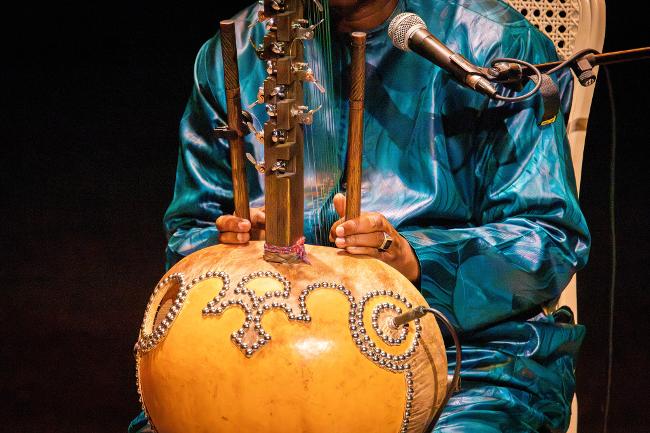
“I’m Ablaye Cissoko,” he says. “I come from the Mandinka people. My instrument is the kora. It’s 800 years old, it has 21 strings, and it doesn’t like the cold.” The kora looks like a lute and sounds like a harp. It sits upright in front of him, his thumbs hidden behind it, busy at the most intricate work that nonetheless appears effortless.
About Prohibitions
From storyteller to keeper of the culture, from musical performer to moral guide, from living archive to venerated speaker of truth, the griot (French), better known as the djali in West Africa, is the guardian of history and the oral tradition, arriving in person when possible, entering the community to meet people face-to-face with tales in song to carry messages to live by.
“Next is one about prohibitions,” Cissoko announced. “They can keep us from speaking. They can keep us from walking. They can keep us from looking. But they can’t keep us from smiling.”
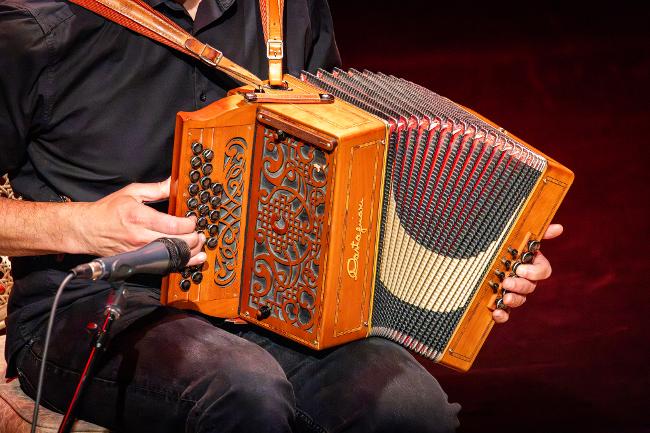
Some of the evening’s repertory was more upbeat in tone, even humorous, as Ablaye Cissoko and Cyrille Brotto teased each other in a playful “echo dialogue” reminiscent of a call-response pattern in blues or jazz or spirituals, but also something new in the improvisation between the kora and the diatonic button accordion, Brotto’s instrument of choice.
A renowned and widely admired musician and composer from France, Cyrille Brotto is steeped in traditional and contemporary folk music across Europe. Hardly the historic melodies we expect from the accordion’s heritage, Brotto’s performances are extremely lyrical as he experiments with new possibilities for expression. In mood and tone, a comparison might be made between his utterances and the delicate and sensitive pieces by Astor Piazzola. Brotto harmonizes wondrously with Cissoko, adding texture and depth to the griot’s velvety voice and the precision of his muted strings and delicate arpeggios. Then accordion brings rhythm and resonance, sustaining the melody of the kora’s clipped strings and Cissoko’s fluid song, often lending a droning, melancholic beauty to the sensation of longing the duo creates. They will end the year of 2026 with more than 50 concerts, touring around the globe with their unique musical “conversations.”
The night marked the second visit of Ablaye Cissoko to the Théâtre Raymond Kabbaz, his return after performing with Constantinople in 2025 in songs from the band’s 2019 album Traversées, inspired by Persian music. The theater, part of the Lycée Française de Los Angeles, is a 220-seat venue that offers incredibly popular presentations of music, theatre, dance, and film. While devoted to celebrations of the French language, the program’s versatility and international scope salutes a rich diversity of artistic traditions. An intimate house with excellent acoustics, lighting, and projection capability is joined by a welcoming patio with a handy wine and baguette bar where fans arrive early to mingle and munch before events that never disappoint.
Ever expanding its program, the TRK will open its doors to its first “Fête de la Musique” on June 21st from 3:00 to 9:00 pm to celebrate the beginning of summer with talents from across Los Angeles. Enjoy the Summer Solstice at the beer garden and both outdoor and indoor stages offering live music performances. Reservations at https://www.theatreraymondkabbaz.com/fete-de-la-musique .
Théâtre Raymond Kabbaz
10361 West Pico Boulevard
Los Angeles, CA 90064
Tel. 310-286-0553